Fleet Digitalization
Digitalize Your Equipment Rental Fleet
Discover how telematics, predictive maintenance and streamlined operations can improve the availability and profitability of your rental fleet.
4 min read

B’Smart Ignition / Fleet Digitalization
Battery health monitoring turns charging events, voltage trends and workshop history into practical information for managing electric machinery fleets.

For machinery rental companies, battery performance is not only a
workshop issue. It directly affects equipment availability, handovers,
charging routines and the confidence with which a machine can be
allocated to its next job. Battery health monitoring
gives fleet and workshop teams a more consistent view of how electric
equipment is being charged and used, helping them move from isolated
observations to decisions based on operational history.

A battery may appear to be a single component, but its condition is
influenced by a sequence of operational events: depth of discharge,
charging frequency, interrupted charges, idle periods, temperature,
workload and maintenance practices. When those events are not recorded,
teams often have to investigate problems after a machine has already
become unavailable.
The operational problem is therefore broader than “knowing the
voltage.” A workshop may need to answer when the machine was last
charged, whether the charge was completed, how its pattern differs from
previous weeks and whether the reported symptom is consistent with the
available telemetry.
This is where fleet digitalization becomes useful. Remote data
creates a timeline that can support diagnosis, planning and
communication. It does not replace an electrical inspection, a
battery-capacity test or the manufacturer’s maintenance procedure.
The exact data available depends on the machine, battery technology,
controller, telematics hardware and installation. A practical system may
collect or derive some of the following information:
Not every machine provides every signal. A direct voltage reading, a
CAN or J1939 message and a value reported by a battery-management system
are different sources and should not be treated as interchangeable.
Before configuring alarms, the team should document where each value
comes from, its expected range and the conditions under which it is
reliable.
B’Smart describes remote monitoring of charge and discharge cycles
among its fleet digitalization features. The relevant capability in each deployment
still depends on compatible equipment, installation and
configuration.
A charging connection is not automatically a complete cycle. A
machine may be connected briefly, disconnected before completion or
charged in several stages. Counting every connection as an identical
cycle can therefore create a misleading picture.
The better approach is to define an operational rule for each machine
family. That rule can combine voltage behaviour, charging duration,
ignition or operating state and the time elapsed between events. The
objective is not to create a laboratory-grade state-of-health estimate
from insufficient data. It is to build a repeatable operational record
that helps identify exceptions.
For example, recurring partial-charge patterns may justify a review
of charging procedures. An unexpected voltage drop while a machine is
idle may trigger an inspection of the battery, installation or connected
systems. Neither pattern proves the cause on its own; it indicates where
the workshop should look first.
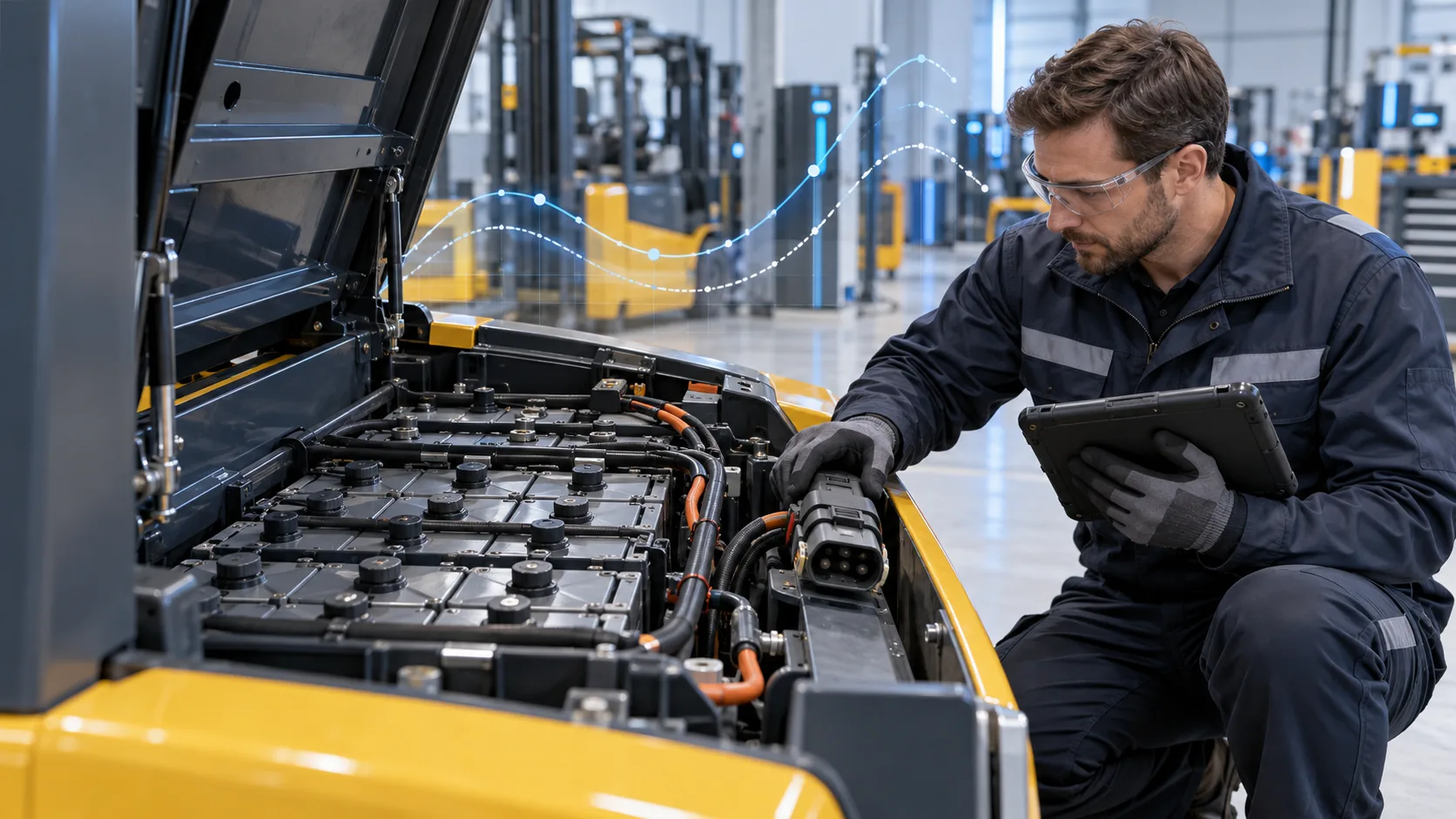
Group equipment by battery type, nominal voltage, charger and normal
duty cycle. A single threshold applied across a mixed fleet will produce
noise. Begin with observed normal behaviour and validate it with the
workshop.
Store the start, end and duration of each relevant event rather than
only the latest value. Historical context allows the team to compare the
current pattern with the same machine’s previous behaviour.
Useful alerts should point to an action: inspect a repeated
interrupted charge, review a machine that remains below an agreed
threshold, or check a unit that is expected to be ready but has not
completed its charging process. Alerts without ownership or a defined
response quickly become background noise.
Battery data becomes more valuable when it is linked to maintenance
notes, component changes, inspections and reported incidents. The result
is a history by machine rather than separate fragments in a dashboard,
spreadsheet and workshop conversation.
Telemetry can prioritise work, but the final assessment should remain
with qualified personnel. Connector condition, electrolyte level where
applicable, charger compatibility, cabling and physical damage may
require an on-site check. B’Smart’s existing guide to traction-battery maintenance provides additional operational context.
A battery dashboard should reduce investigation time, not simply add
charts. For fleet managers and rental operations, it should make it easy
to identify:
Role-based views are important. A workshop user may need detailed
signals and event history, while a branch manager may need availability,
exceptions and pending actions. Both views should refer to the same
underlying machine record.
The strongest benefit of battery health monitoring is not a single
alarm. It is the ability to combine charging behaviour, machine use and
workshop history in one operational process. This makes it easier to
prioritise inspections, standardise charging practices and discuss
incidents using a shared timeline.
The limits must remain clear. Telematics does not automatically
measure every aspect of battery health, and an inferred cycle is not the
same as a certified capacity test. Data quality, compatible signals and
correctly defined rules determine what can be concluded.
For rental fleets, the practical next step is to select one
representative machine family, document its charging process and
validate the available signals with the workshop. From there, the team
can define useful exceptions and scale the model without creating
unnecessary alarm noise.
Explore how B’Smart digitalizes machinery fleet management or contact the team to review
which battery and charging signals are available in your fleet.
Fleet Digitalization
Discover how telematics, predictive maintenance and streamlined operations can improve the availability and profitability of your rental fleet.
B’Smart IoT
Discover which data you need to anticipate breakdowns and improve your machinery availability.